

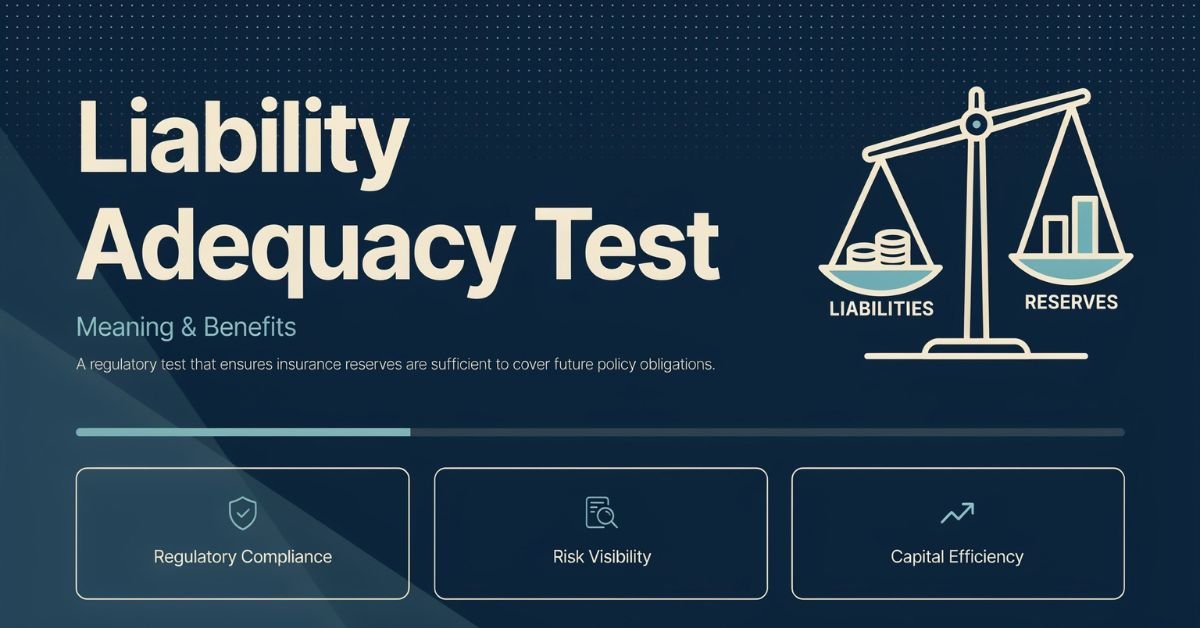
A Liability Adequacy Test is an important assessment used to determine whether the recognized liabilities related to insurance contracts are sufficient to cover expected future obligations. It helps identify situations where the amount currently recognized may not be enough to meet expected claims, expenses, and other related cash flows.
In simple terms, the test asks an important question: Are the liabilities already recorded sufficient to cover the obligations that are expected in the future?
For insurance businesses and financial reporting, understanding this concept can help improve transparency, risk assessment, and the reliability of reported financial information.
What Is a Liability Adequacy Test?
A Liability Adequacy Test is a process used to assess whether the carrying amount of recognized insurance liabilities is adequate when compared with the present value of expected future cash flows and other relevant obligations.
The assessment generally considers information such as:
- Expected future claims
- Future claim-related expenses
- Administrative or other relevant expenses
- Expected cash inflows and outflows
- Timing of future payments
- Relevant assumptions and uncertainties
- Existing recognized liabilities
If the estimated future obligations are greater than the liabilities already recognized, the difference may indicate a liability shortfall that needs to be considered under the applicable accounting requirements.
The exact methodology and accounting treatment can vary depending on the applicable accounting framework and the nature of the insurance contracts.
Why Is the Liability Adequacy Test Important?
Insurance companies often have obligations that extend into the future. A claim may be reported or paid months or years after an insurance contract begins. This creates uncertainty when estimating the amount needed to satisfy future obligations.
A Liability Adequacy Test helps organizations evaluate whether their recorded liabilities remain sufficient based on current information and reasonable assumptions.
The assessment can be important because it may help with:
- Identifying potential liability shortfalls
- Improving the reliability of financial statements
- Evaluating future obligations
- Supporting risk management
- Reviewing assumptions used in liability measurement
- Providing more transparent financial information
The test is therefore not simply a mathematical exercise. It involves estimating future events and evaluating the assumptions used to measure financial obligations.
How Does a Liability Adequacy Test Work?
The process can be explained through several general steps. The exact process depends on the applicable accounting requirements and the type of insurance contracts being assessed.
1. Identify the Relevant Liabilities
The first step is to identify the insurance liabilities that are subject to assessment.
The organization needs to understand what obligations have already been recognized and what future obligations are connected with those contracts.
2. Estimate Future Cash Flows
Next, expected future cash flows are estimated.
These may include payments associated with:
- Future claims
- Claim settlement costs
- Policy-related expenses
- Other contractual obligations
- Relevant administrative expenses
The estimates should be based on appropriate data and reasonable assumptions.
3. Consider the Timing of Payments
The timing of future cash flows can affect their value.
For example, receiving or paying $100,000 today is financially different from paying the same amount several years in the future. Where the applicable accounting framework requires it, future cash flows may therefore be discounted to reflect their timing.
4. Compare Expected Obligations With Recognized Liabilities
The estimated future obligations are then compared with the relevant liabilities already recognized in the financial statements.
If the recognized amount is sufficient based on the applicable requirements, the liability may be considered adequate.
If expected obligations exceed the recognized amount, a potential deficiency may exist.
5. Evaluate Any Shortfall
When a shortfall is identified, the organization needs to determine the appropriate accounting treatment under the applicable accounting framework.
This step is important because the accounting consequences can depend on the relevant standard, contract classification, measurement model, and circumstances.
Key Components of a Liability Adequacy Test
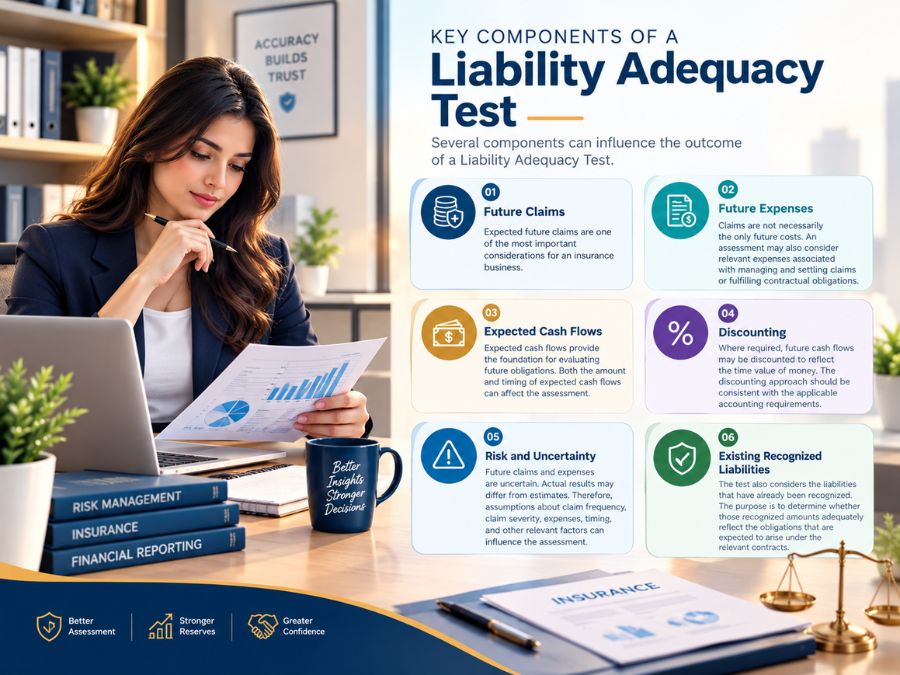
Several components can influence the outcome of a Liability Adequacy Test.
Future Claims
Expected future claims are one of the most important considerations for an insurance business.
Historical claims data, current experience, contract information, and other relevant evidence may be considered when estimating future claims.
Future Expenses
Claims are not necessarily the only future costs.
An assessment may also consider relevant expenses associated with managing and settling claims or fulfilling contractual obligations, depending on the applicable requirements.
Expected Cash Flows
Expected cash flows provide the foundation for evaluating future obligations.
Both the amount and timing of expected cash flows can affect the assessment.
Discounting
Where required, future cash flows may be discounted to reflect the time value of money.
The discounting approach should be consistent with the applicable accounting requirements.
Risk and Uncertainty
Future claims and expenses are uncertain. Actual results may differ from estimates.
Therefore, assumptions about claim frequency, claim severity, expenses, timing, and other relevant factors can influence the assessment.
Existing Recognized Liabilities
The test also considers the liabilities that have already been recognized.
The purpose is to determine whether those recognized amounts adequately reflect the obligations that are expected to arise under the relevant contracts.
Liability Adequacy Test Example
Consider a simplified example.
Suppose an insurer has recognized $800,000 of liabilities related to a group of insurance contracts.
After reviewing available information, the insurer estimates that the relevant future obligations have a present value of approximately $900,000.
The simplified comparison would be:
| Item | Amount |
| Recognized liabilities | $800,000 |
| Estimated future obligations | $900,000 |
| Potential shortfall | $100,000 |
In this simplified example, the estimated obligations are $100,000 higher than the recognized liabilities.
This may indicate that the existing liability is not adequate based on the assumptions used in the assessment.
However, this example is only for educational purposes. Actual insurance liability calculations can be considerably more complex and depend on the applicable accounting framework, contract terms, assumptions, and measurement requirements.
What Happens When Liabilities Are Inadequate?
If the assessment indicates that recognized liabilities are insufficient, the organization may need to recognize or otherwise account for the identified deficiency according to the applicable accounting requirements.
The purpose is to prevent financial statements from understating relevant obligations.
For example, if expected future obligations increase because of higher-than-expected claims, changes in expenses, or updated assumptions, previously recognized liabilities may need to be reassessed.
The specific accounting treatment should be determined according to the relevant accounting standard and the circumstances of the contracts being evaluated.
Benefits of a Liability Adequacy Test

A properly performed Liability Adequacy Test can provide several useful benefits.
1. Better Financial Transparency
The assessment can help ensure that reported liabilities are evaluated against expected future obligations.
This can give users of financial statements a clearer understanding of potential obligations.
2. Improved Risk Assessment
Insurance businesses face uncertainty because future claims and expenses cannot always be predicted precisely.
Testing liability adequacy can help identify areas where assumptions or estimates may require additional review.
3. More Reliable Liability Measurement
Regular evaluation can help organizations determine whether recognized amounts remain appropriate based on available information.
4. Early Identification of Potential Shortfalls
A test can highlight situations where expected obligations may exceed currently recognized liabilities.
Identifying a potential issue earlier can give management more time to investigate the underlying assumptions and circumstances.
5. Better Financial Decision-Making
Reliable liability information can support financial analysis, planning, risk management, and other business decisions.
Liability Adequacy Test vs. Other Liability Assessments
A Liability Adequacy Test should not automatically be treated as identical to every other liability measurement or valuation process.
| Aspect | Liability Adequacy Test | General Liability Assessment |
| Main purpose | Evaluate whether relevant recognized liabilities are adequate | Measure or assess a liability |
| Focus | Expected obligations compared with recognized amounts | Depends on the specific liability |
| Future cash flows | Often an important consideration | May or may not be central |
| Insurance relevance | Particularly relevant in insurance contexts | Applies across many industries |
| Outcome | May identify a potential shortfall | Produces a liability measurement or assessment |
The terminology and exact requirements can differ depending on the accounting framework being applied.
Common Challenges in a Liability Adequacy Test
Performing the assessment can be challenging because future obligations are uncertain.
Forecasting Future Claims
Future claims can be affected by changes in customer behavior, economic conditions, claim patterns, and other factors.
Historical data can be useful, but past results do not always perfectly predict future outcomes.
Estimating Expenses
Future expenses may also be difficult to estimate, particularly when costs change over time.
Selecting Appropriate Assumptions
Small changes in assumptions can sometimes produce significant differences in estimated future obligations.
Therefore, assumptions should be carefully selected, documented, and reviewed.
Economic Changes
Inflation, interest rates, market conditions, and other economic factors may influence future cash flows and their present value.
Data Quality
The quality of the underlying data can directly affect the reliability of the assessment.
Incomplete, outdated, or inconsistent data can make the resulting estimates less reliable.
Best Practices for Performing a Liability Adequacy Test

Organizations can improve the quality of their assessment by following several practical approaches.
Use Reliable Data
Use relevant and sufficiently reliable historical and current information when developing assumptions.
Review Assumptions Regularly
Assumptions should be reviewed when new information becomes available or when experience changes significantly.
Document the Methodology
The organization should maintain clear documentation explaining the data, assumptions, calculations, and judgments used in the assessment.
Apply the Relevant Accounting Requirements
The methodology should be consistent with the accounting framework and requirements applicable to the contracts being assessed.
Monitor Actual Results
Comparing previous estimates with actual outcomes can help identify areas where assumptions may need refinement.
Use Appropriate Professional Judgment
Because future obligations involve uncertainty, professional judgment may be necessary. Significant judgments should be supported by relevant evidence and properly documented.
Conclusion
A Liability Adequacy Test helps assess whether recognized insurance liabilities are sufficient in light of expected future obligations. By considering factors such as future claims, expenses, cash flows, timing, and uncertainty, organizations can identify potential deficiencies and evaluate whether their reported liabilities remain appropriate.
The assessment is especially important in insurance-related financial reporting because future obligations can be uncertain and may extend over long periods.
For accurate financial reporting, organizations should use reliable data, carefully review assumptions, document their methodology, and apply the accounting requirements relevant to their specific contracts and circumstances.
Understanding the Liability Adequacy Test therefore provides a useful foundation for anyone studying insurance accounting, financial reporting, liability measurement, or risk management.
FAQs
What is a Liability Adequacy Test?
A Liability Adequacy Test is an assessment used to determine whether recognized liabilities are sufficient to cover expected future obligations under the applicable accounting requirements.
Why is the Liability Adequacy Test performed?
It is performed to identify whether recognized liabilities may be insufficient when compared with relevant expected future obligations.
How is a Liability Adequacy Test calculated?
A simplified approach involves estimating relevant future cash flows, considering their timing and other applicable factors, and comparing the resulting amount with recognized liabilities. Actual calculations depend on the applicable accounting framework.
What happens if liabilities are inadequate?
If a shortfall is identified, the organization may need to recognize or otherwise account for the deficiency according to the applicable accounting requirements.
Who uses a Liability Adequacy Test?
The concept is particularly relevant to insurance businesses and professionals involved in insurance accounting, financial reporting, actuarial analysis, and risk management.
1 thought on “Liability Adequacy Test: Meaning & Benefits ”