
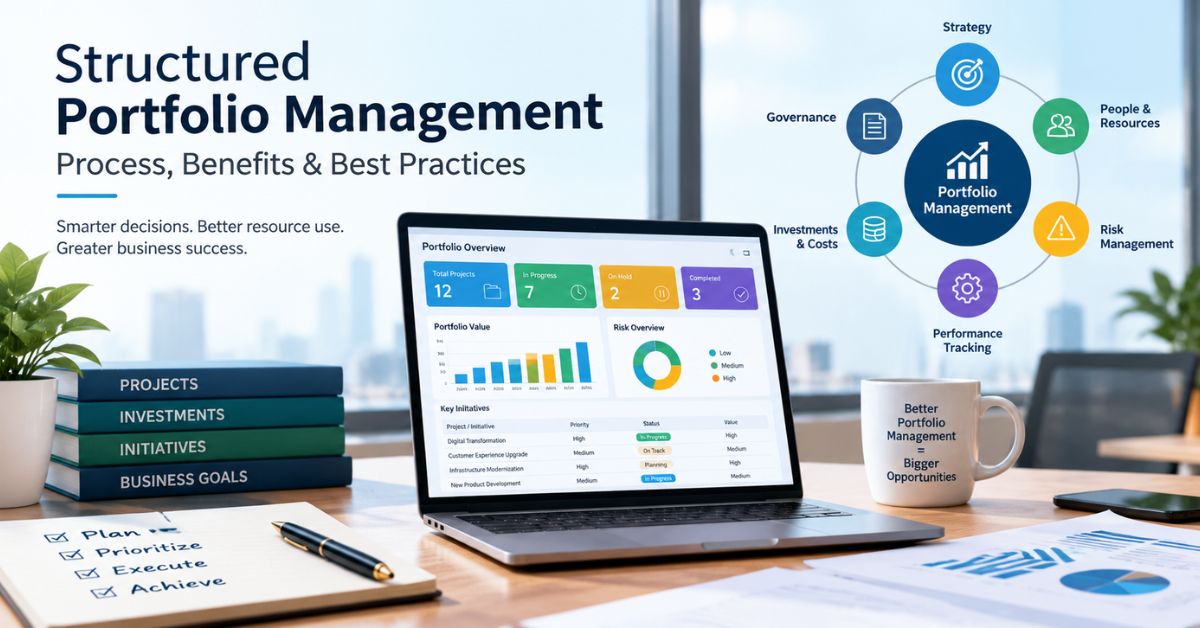
Managing multiple projects, investments, or business initiatives can become difficult when decisions are made without a clear system. Structured Portfolio Management provides an organized approach for evaluating, prioritizing, and monitoring different items within a portfolio.
Structured Portfolio Management: Process, Benefits & Best Practices . It can also improve visibility into risks, costs, performance, and resource requirements. This guide explains what Structured Portfolio Management means, how it works, its benefits, key components, challenges, and best practices.
What Is Structured Portfolio Management?
Structured Portfolio Management is a systematic approach to selecting, organizing, prioritizing, monitoring, and reviewing multiple projects, investments, or initiatives as a portfolio.
Instead of managing each item separately, organizations evaluate the portfolio as a whole. This makes it easier to understand how individual projects or investments support broader business objectives.
A structured portfolio typically uses defined criteria, performance measures, risk assessments, resource information, and regular reviews. These elements help decision-makers determine where resources should be directed and which activities require changes.
For example, a technology company may have several software development projects running at the same time. Structured Portfolio Management can help the company compare their strategic value, costs, risks, expected benefits, and resource requirements before making portfolio decisions.
How Structured Portfolio Management Works
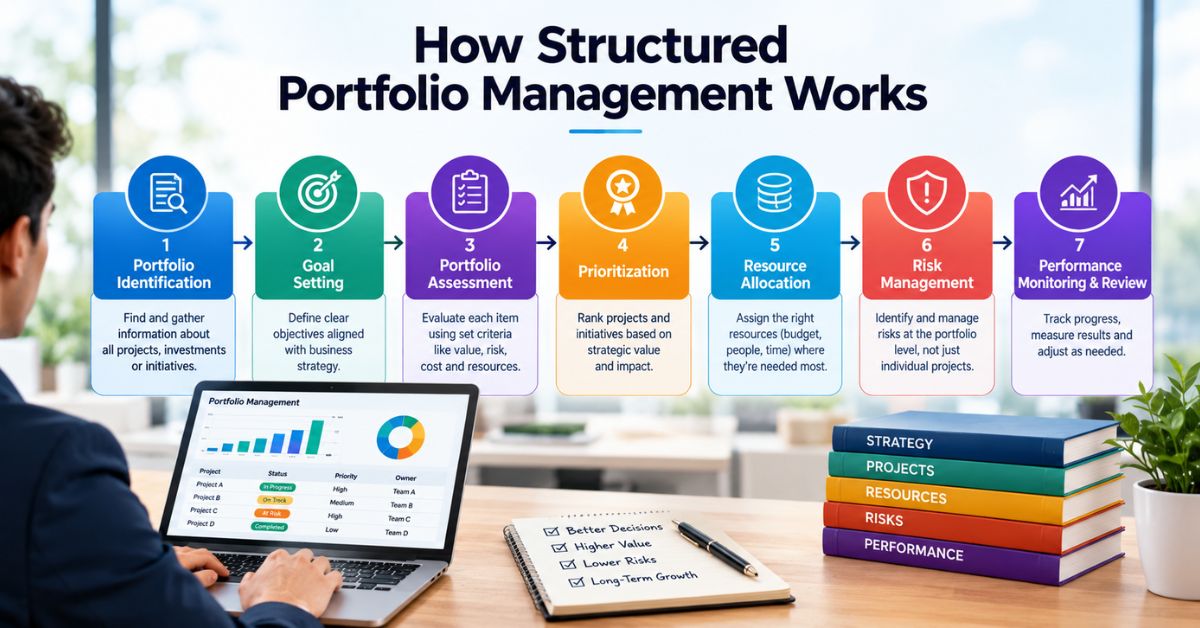
Structured Portfolio Management generally follows a series of connected steps. The exact process can vary depending on the organization, industry, and type of portfolio.
Portfolio Identification
The first step is identifying the projects, investments, products, or initiatives that belong to the portfolio.
Organizations should collect relevant information about each item, including its objectives, estimated costs, expected benefits, current status, resources, and risks.
Having consistent information makes comparison easier.
Goal Setting
The portfolio should have clear objectives.
These objectives may relate to revenue growth, cost reduction, customer experience, innovation, operational efficiency, risk reduction, or other strategic priorities.
Clear goals provide a framework for evaluating portfolio items.
Portfolio Assessment
Each item is assessed using relevant criteria.
An organization may consider factors such as:
- Strategic alignment
- Expected benefits
- Cost
- Risk
- Resource requirements
- Time to completion
- Business impact
- Dependencies
Using consistent assessment criteria can make portfolio decisions more transparent.
Prioritization
After assessment, portfolio items can be prioritized according to organizational objectives.
A high-priority project may have strong strategic value but require significant resources. Another project may have lower risk but provide fewer long-term benefits.
Prioritization helps decision-makers understand these differences before allocating resources.
Resource Allocation
Organizations have limited budgets, employees, technology, and time.
Structured Portfolio Management helps decision-makers evaluate where these resources are needed most based on defined portfolio objectives.
Resource allocation should also consider dependencies between projects. Delaying one initiative, for example, may affect several other activities.
Risk Management
Portfolio-level risk management looks beyond individual project risks.
Decision-makers can examine whether several projects depend on the same supplier, technology, market condition, or internal resource.
This broader view can reveal concentration risks that may not be obvious when projects are reviewed separately.
Performance Monitoring
Portfolio performance should be monitored using relevant metrics.
Organizations may track:
- Budget performance
- Project progress
- Expected benefits
- Resource utilization
- Risk exposure
- Milestone completion
- Return on investment
- Strategic contribution
Regular monitoring helps identify problems before they become larger portfolio issues.
Continuous Improvement
Portfolio management is not a one-time activity.
Business conditions, customer needs, budgets, technologies, and strategic goals can change. Organizations should therefore review their portfolios regularly and adjust priorities when necessary.
Key Components of Structured Portfolio Management
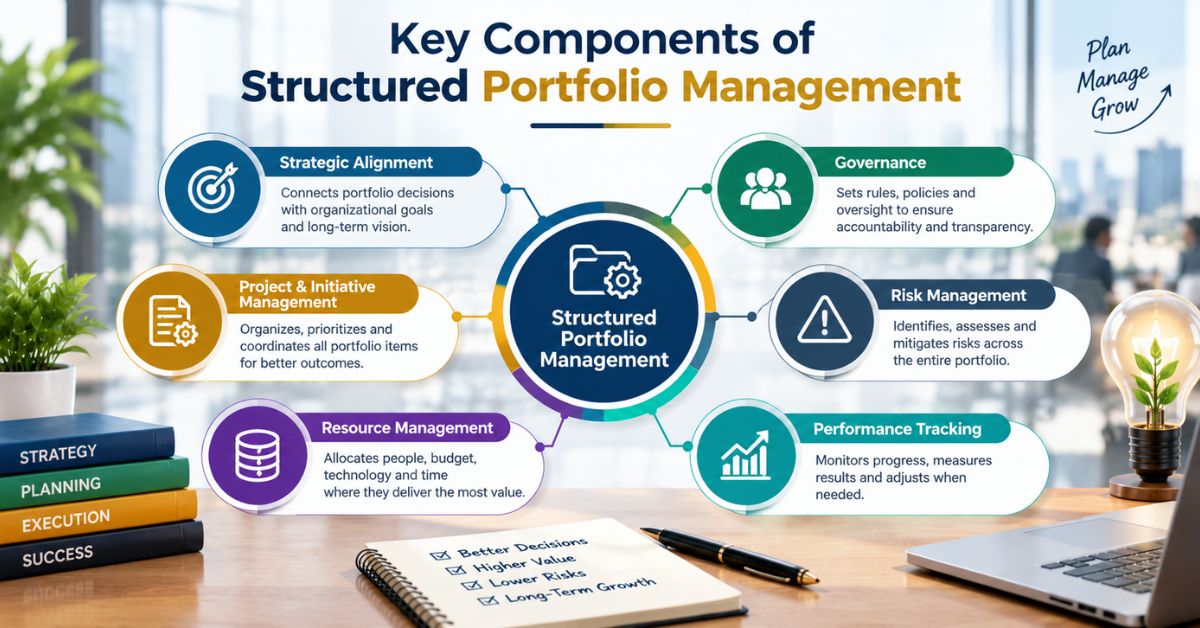
Several components work together to create an effective portfolio management framework.
Strategic Alignment
Strategic alignment means connecting portfolio decisions with organizational goals.
A project may be valuable on its own but may not support the organization’s current strategy. Reviewing strategic alignment helps decision-makers understand whether portfolio resources are being directed toward important objectives.
Portfolio Selection
Portfolio selection involves determining which projects, investments, or initiatives should be included.
Organizations can use defined evaluation criteria to compare potential portfolio items before committing resources.
Prioritization
Prioritization helps organizations determine which activities deserve attention and resources.
Factors such as strategic importance, expected value, urgency, risk, and available resources can influence priority decisions.
Resource Management
Resource management focuses on making effective use of available people, budgets, technology, and time.
A structured portfolio view can highlight resource conflicts between different projects.
Risk Assessment
Risk assessment identifies potential events that could affect portfolio performance.
Portfolio-level assessment can also reveal shared risks and dependencies across multiple initiatives.
Performance Measurement
Performance measurement provides information about whether portfolio items are delivering expected results.
Organizations can use financial and non-financial metrics depending on their objectives.
Governance
Governance establishes roles, responsibilities, decision-making processes, reporting requirements, and review procedures.
Clear governance can help ensure that portfolio decisions follow agreed rules.
Data and Reporting
Reliable data supports better portfolio decisions.
Dashboards and reports can bring information about costs, schedules, risks, resources, and performance into one view.
Benefits of Structured Portfolio Management
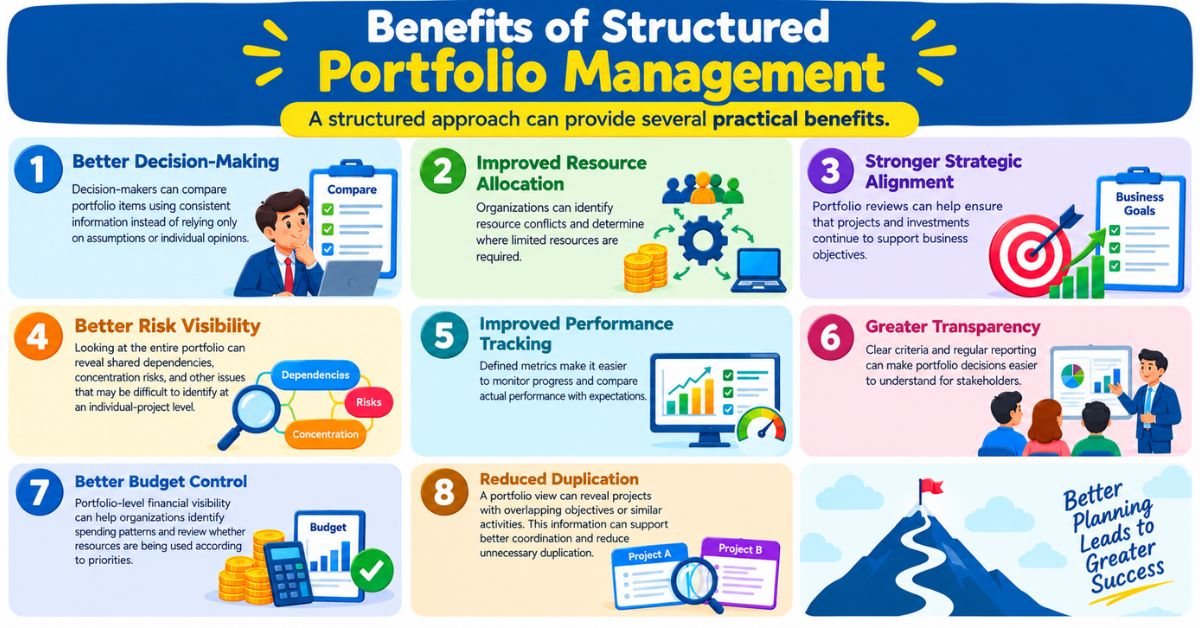
A structured approach can provide several practical benefits.
Better Decision-Making
Decision-makers can compare portfolio items using consistent information instead of relying only on assumptions or individual opinions.
Improved Resource Allocation
Organizations can identify resource conflicts and determine where limited resources are required.
Stronger Strategic Alignment
Portfolio reviews can help ensure that projects and investments continue to support business objectives.
Better Risk Visibility
Looking at the entire portfolio can reveal shared dependencies, concentration risks, and other issues that may be difficult to identify at an individual-project level.
Improved Performance Tracking
Defined metrics make it easier to monitor progress and compare actual performance with expectations.
Greater Transparency
Clear criteria and regular reporting can make portfolio decisions easier for stakeholders to understand.
Better Budget Control
Portfolio-level financial visibility can help organizations identify spending patterns and review whether resources are being used according to priorities.
Reduced Duplication
A portfolio view can reveal projects with overlapping objectives or similar activities. This information can support better coordination and reduce unnecessary duplication.
Structured Portfolio Management Process
Organizations can use the following framework to build a structured portfolio management process.
Step 1: Define Portfolio Objectives
Start by identifying what the portfolio is expected to achieve.
Objectives should be clear enough to guide evaluation and prioritization.
Step 2: Identify Portfolio Items
Create a complete list of current and proposed projects, investments, products, or initiatives.
Collect consistent information for each item.
Step 3: Collect Relevant Data
Gather information about costs, benefits, risks, resources, timelines, dependencies, and strategic relevance.
Step 4: Evaluate Each Item
Use consistent criteria to assess portfolio items.
A scoring framework may be useful when many initiatives need to be compared.
Step 5: Prioritize Initiatives
Rank or group initiatives according to agreed business criteria.
The objective is to understand how different items contribute to portfolio goals.
Step 6: Allocate Resources
Review available resources and determine how they can support portfolio priorities.
Consider both current requirements and future needs.
Step 7: Monitor Performance
Track portfolio metrics regularly.
Use dashboards and reports to identify changes in performance, risks, costs, and expected benefits.
Step 8: Review and Adjust
Conduct regular portfolio reviews.
Projects may need additional resources, changes in scope, revised priorities, or other adjustments when business conditions change.
Structured Portfolio Management Best Practices
Organizations can improve their approach by following several practical practices.
Set Measurable Objectives
Clear objectives make it easier to determine whether portfolio activities are producing the expected results.
Use Consistent Evaluation Criteria
Apply similar criteria when comparing portfolio items. This can make decision-making more transparent and easier to explain.
Review the Portfolio Regularly
A portfolio that was appropriate several months ago may require changes because of new business conditions, risks, technologies, or customer requirements.
Track Risks and Dependencies
Do not focus only on individual project risks. Examine connections between projects and identify risks that could affect several initiatives.
Use Reliable Data
Portfolio decisions depend on the quality of the information available. Keep financial, operational, resource, and performance data accurate and current.
Keep Stakeholders Informed
Regular communication can help stakeholders understand portfolio priorities, changes, risks, and performance.
Connect Decisions With Business Strategy
Portfolio decisions should remain connected to organizational goals rather than being based only on short-term considerations.
Document Portfolio Decisions
Documenting major decisions creates a useful record of why priorities, resources, or portfolio items were changed.
Challenges of Structured Portfolio Management
Although a structured approach can improve portfolio oversight, organizations can still face several challenges.
Limited Resources
Organizations may have more potential projects than available people, money, or technology.
Solution: Establish clear priorities and regularly compare resource requirements with available capacity.
Conflicting Priorities
Different departments may have different goals.
Solution: Use shared portfolio objectives and transparent evaluation criteria.
Poor-Quality Data
Incomplete or outdated information can affect portfolio decisions.
Solution: Establish clear data ownership and update important portfolio information regularly.
Changing Business Goals
Market conditions and organizational strategies can change.
Solution: Review portfolio alignment regularly and adjust priorities when business objectives change.
Stakeholder Disagreements
Stakeholders may have different views about which projects deserve priority.
Solution: Use documented criteria, reliable data, and defined governance processes to support discussions.
Risk Uncertainty
Future costs, benefits, market conditions, and project outcomes may not always be predictable.
Solution: Track assumptions and risks continuously rather than treating the initial assessment as permanent.
Lack of Governance
Without clear responsibilities, portfolio decisions may become inconsistent.
Solution: Define who can approve, change, pause, or remove portfolio items.
Tools and Technology for Portfolio Management
Modern technology can support Structured Portfolio Management by bringing portfolio information into a central system.
Portfolio Management Software
Portfolio management platforms can help organizations track projects, budgets, resources, risks, and performance.
Project Management Platforms
Project management tools can provide information about schedules, tasks, milestones, teams, and dependencies.
Business Intelligence Dashboards
Business intelligence dashboards can turn portfolio data into visual reports. Decision-makers can use dashboards to monitor trends and identify areas that require attention.
Data Analytics
Analytics can help organizations examine historical performance, resource usage, costs, and other portfolio information.
Automated Reporting
Automated reports can reduce manual reporting work and help stakeholders receive updated information more consistently.
AI-Assisted Analysis
AI-based tools can support tasks such as identifying patterns, summarizing portfolio data, highlighting potential risks, and preparing reports. Human review remains important when decisions involve significant financial, operational, or strategic consequences.
Structured Portfolio Management Example
Consider a company that is managing five technology projects.
The projects include:
- A customer mobile application
- An internal employee platform
- A cybersecurity upgrade
- A data analytics project
- A website redesign
The company has a limited technology budget and cannot give every project the same level of funding.
Using Structured Portfolio Management, the company can evaluate each project based on strategic alignment, expected benefits, cost, risk, resource requirements, and dependencies.
The cybersecurity project may require urgent attention because of its risk profile. The mobile application may have strong customer and revenue objectives. The website redesign may require fewer resources but have a different level of strategic importance.
Instead of making decisions independently, the company can review all five projects together. This provides a broader view of how the projects compete for resources and contribute to overall business goals.
The portfolio can then be reviewed regularly as project performance and business priorities change.
Structured Portfolio Management vs. Traditional Portfolio Management
The two approaches can differ in how portfolio decisions are organized.
| Area | Structured Approach | Less Structured Approach |
| Decision-making | Uses defined criteria and processes | May rely more on informal decisions |
| Prioritization | Based on agreed objectives and evaluation factors | May change without consistent criteria |
| Risk management | Reviews individual and portfolio-level risks | Often focuses mainly on individual items |
| Resource allocation | Considers portfolio-wide requirements | May happen separately across projects |
| Performance monitoring | Uses defined metrics and regular reviews | May rely on inconsistent reporting |
| Governance | Defines roles and decision processes | Responsibilities may be less clear |
| Adaptability | Uses regular reviews to adjust priorities | Changes may happen reactively |
The appropriate approach depends on the organization’s size, goals, portfolio complexity, resources, and governance requirements.
How to Improve Structured Portfolio Management
Organizations can strengthen their portfolio management practices by focusing on several areas.
First, improve the quality of portfolio data. Decision-makers need accurate information about costs, resources, risks, progress, and expected benefits.
Second, establish clear KPIs. Metrics should reflect the organization’s objectives and provide useful information about portfolio performance.
Third, conduct regular portfolio reviews. These reviews should examine whether initiatives remain strategically relevant and whether their expected benefits and risks have changed.
Fourth, strengthen governance. Clearly defined responsibilities can reduce confusion about who makes portfolio decisions.
Fifth, use dashboards and automated reporting where appropriate. Technology can make portfolio information easier to access and understand.
Finally, maintain open communication with stakeholders. Portfolio priorities can affect multiple teams, so stakeholders should understand important changes and the reasons behind them.
FAQs
What is Structured Portfolio Management?
Structured Portfolio Management is a systematic method for selecting, prioritizing, managing, monitoring, and reviewing multiple projects, investments, or initiatives as a portfolio.
Why is Structured Portfolio Management important?
It helps organizations evaluate multiple initiatives using consistent information and connect resource allocation with strategic objectives.
How does Structured Portfolio Management work?
It generally involves defining objectives, identifying portfolio items, collecting data, evaluating initiatives, prioritizing them, allocating resources, monitoring performance, and reviewing the portfolio regularly.
What are the main benefits of Structured Portfolio Management?
Key benefits include improved decision-making, better resource visibility, stronger strategic alignment, improved risk visibility, performance tracking, transparency, and budget oversight.
What are the main components of portfolio management?
Important components include strategic alignment, portfolio selection, prioritization, resource management, risk assessment, performance measurement, governance, and reporting.
Conclusion
Structured Portfolio Management provides an organized way to manage multiple projects, investments, and initiatives as one connected portfolio. By using clear objectives, consistent evaluation criteria, resource planning, risk assessment, performance measurement, and regular reviews, organizations can gain a better understanding of their portfolio.
The process should not remain static. Business goals, resources, risks, and market conditions can change over time. Regular portfolio reviews allow organizations to update priorities and keep their portfolio aligned with current objectives.
A practical Structured Portfolio Management framework combines reliable data, clear governance, effective communication, and appropriate technology. When these elements work together, decision-makers have a stronger foundation for managing complex portfolios and making informed resource decisions.